class: title, center, middle # Latin Dance Music: Cuban Musical Legacies  ### Christopher Witulski, Ph.D. ### College of Musical Arts --- # Outline * Colonial history in Cuba * Santariá and batá drumming * Rumba * Mambo * Salsa --- # Cuba .image-float-right.image-50[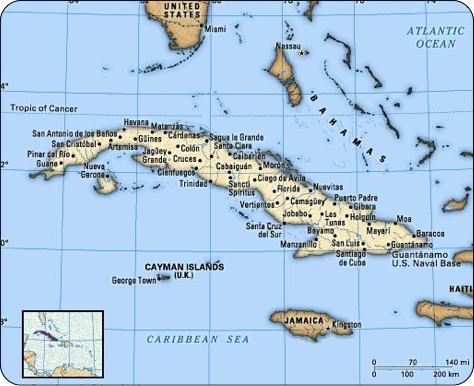] * “Latin Dance Music” * Cuba-centered definition * Genres * Santaria, batá, rumba * Son * Cha cha chá, danzón, mambo * Salsa, latin jazz --- # Colonization * 1492: Columbus sailed the... * 1511: Spanish settlers, plantations * “Eradication” of Taino (Native American population) * 1790-1860: Height of the slave trade * Primarily from Yoruba and Congolese areas * Leads to more “African” sounds * Different treatment in Catholic and Protestant areas * Easier to buy freedom, communities of slave/free populations --- # Santaría * Syncretic religion: Yoruba/Catholic .image-float-right.image-50[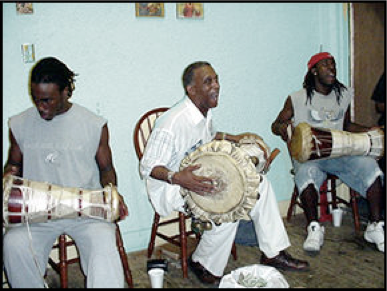] * Batá drumming * Sacred * 3 drums, bells attached to lowest (“mother”) drum * Polyrhythmic * Orishas * Shango: God of Thunder * Yemaya: Seas and Lakes * Obatalá: King of Kings --- class: middle, center <!-- <video width="560" height="360" controls> <source src="/assets/la-fuerza-del-tambor.mp4" type="video/mp4"> <source src="/assets/la-fuerza-del-tambor.ogv" type="video/ogg"> </video> --> <iframe width="560" height="315" src="https://www.youtube.com/embed/0sPI_a9t1Ew?si=yGvp8QcPQ_k6v58q&start=36" title="YouTube video player" frameborder="0" allow="accelerometer; autoplay; clipboard-write; encrypted-media; gyroscope; picture-in-picture; web-share" referrerpolicy="strict-origin-when-cross-origin" allowfullscreen></iframe> ### Batá drumming clip --- # Rumba * Secular counterpart * African and European characteristics * African influences include: call and response, improvisation, rhythmic complexity * European: Scale structures, Andalusian poetic forms * Instruments * Clave (rhythm and instrument), pg. 224 * Catá: sticks * 3 drums (can be congas, used to be wooden boxes) * Cajon (box of salted codfish), dresser drawers, etc. --- # Rumba * Three-part form: *diana*, verse, *montuno* * Diana: Andalusian style, sung on “la”, introduces scale * Verse: song lyrics, often in Spanish * Montuno: call and response, introduction of dancers, growing intensity, includes “breaks” * “Consuelate Como Yo” * Listen to *diana* section * Listen for *clave* pattern <audio controls="controls"> <source src="/assets/consuelate-como-yo-guaguanco-carlos-embale.m4a" type="audio/mpeg"> </audio> .image-float-right.image-100[] --- # Rumba * Types * Yambú: couples, slowest, elegant, calm, elderly * Guaguanco: couples, more aggressive, most popular * Columbia: solo male dance * Yambú and Guaguanco from *yuka* * Congolese dance, miming rooster and hen * Guaguanco includes *vacynao* --- class: middle, center <!-- <video width="560" height="360" controls> <source src="/assets/clave-y-guaguanco-from-y-tenemos-sabor.mp4" type="video/mp4"> <source src="/assets/clave-y-guaguanco-from-y-tenemos-sabor.ogv" type="video/ogg"> </video> --> <iframe width="560" height="315" src="https://www.youtube.com/embed/cpIrnv3fS6o?si=q179XbFxna1zK-W-&start=30" title="YouTube video player" frameborder="0" allow="accelerometer; autoplay; clipboard-write; encrypted-media; gyroscope; picture-in-picture; web-share" referrerpolicy="strict-origin-when-cross-origin" allowfullscreen></iframe> ### Rumba from a 1967 film, *Y Tenemos Sabor* (0:30) --- class: middle, center <!-- <video width="560" height="360" controls> <source src="/assets/rumba-guaguanco.mp4" type="video/mp4"> <source src="/assets/rumba-guaguanco.mp4" type="video/ogg"> </video> --> <iframe width="560" height="315" src="https://www.youtube.com/embed/gJVT_5swkhA?si=SMSkHONXdPwCPuJm" title="YouTube video player" frameborder="0" allow="accelerometer; autoplay; clipboard-write; encrypted-media; gyroscope; picture-in-picture; web-share" referrerpolicy="strict-origin-when-cross-origin" allowfullscreen></iframe> ### Rumba guaguanco example (note rooster/hen) --- # Let's try it * Guaguancó pattern * L/R shows hand, you can ignore them .image-float-right.image-100[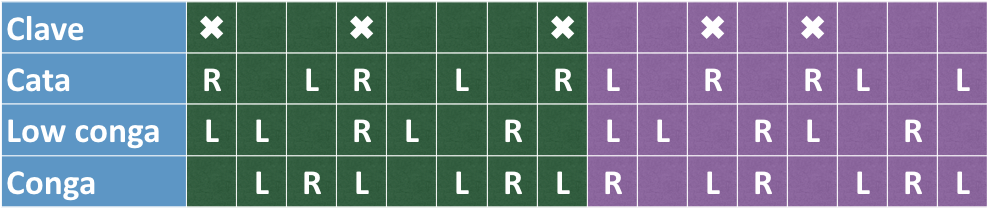] --- # Let's try it * Guaguancó pattern * L/R shows hand, you can ignore them .image-float-right.image-100[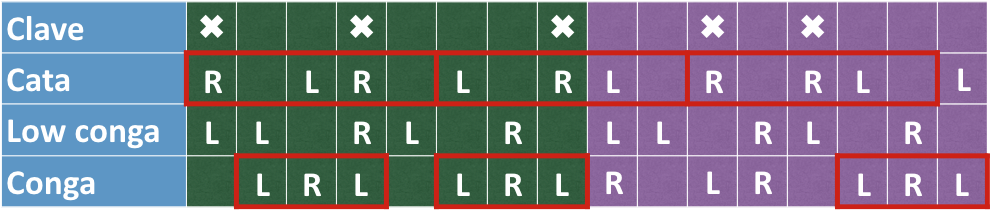] --- # Pre-Revolutionary Havana .image-float-right.image-40[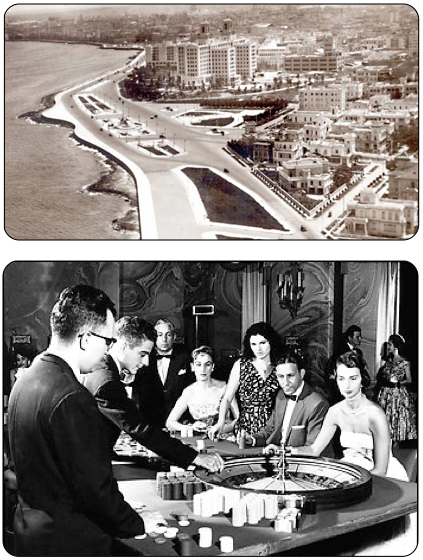] * Gambling, port city * Run by mafia, mob * Think Godfather 2 * Sex tourism * Celebrity hotspot (Sinatra, JFK) * Rampant capitalism leads directly to Castro’s revolution --- # Danzón and Son * Late 1800s, pop music included waltzes, mazurkas, minuets * Cuban whites’ disenchantment (corruption, inefficiency from Spain), led to creation of hybrid forms * *Contradanza*, *danzón*: new, racially inclusive conception of Cuban identity, wide international popularity * By 1920s danzón is “national dance” * During the 20s, however, son rivals the danzón * Increased use of conga, afro-cuban drumming * Sexteto Habanero “La Loma De Belén” * Formed in 1918, working class, “put son in a tuxedo” <audio controls="controls"> <source src="/assets/la-loma-de-belen-sexteto-habanero.m4a" type="audio/mpeg"> </audio> --- class: middle, center <!-- <video width="560" height="360" controls> <source src="/assets/septeto-nacional-suavecito.mp4" type="video/mp4"> <source src="/assets/septeto-nacional-suavecito.ogv" type="video/ogg"> </video> --> <iframe width="560" height="315" src="https://www.youtube.com/embed/iGtcBrVZFAA?si=QQbCcfEP-rLxQB1j" title="YouTube video player" frameborder="0" allow="accelerometer; autoplay; clipboard-write; encrypted-media; gyroscope; picture-in-picture; web-share" referrerpolicy="strict-origin-when-cross-origin" allowfullscreen></iframe> ### Septeto Nacional: “Suavecito” --- # Danzón-Mambo * *Charanga* groups (danzón) adopt *son* style * Add congas, cowbell, timbales – modern “kit” * Formal “mambo” sections: extended, arranged layers, ostinatos, heavily syncopated violin, flute lines * Fed into development of *cha cha chá* and big band mambo --- # Danzón-Mambo .image-float-right.image-40[] * Enrique Jorrin (“La Engañadora”) * Violinist, formed Orquesta América * “Invented” *cha cha chá* to be accessible, easy to dance, marketed to international audiences * Square, 4-beat (1-2-cha cha chá) * Popularity through mid 50s, fizzled due to simplicity <audio controls="controls"> <source src="/assets/la-enganadora.m4a" type="audio/mpeg"> </audio> --- # Mambo (Big Band) * Characteristics * Big band instrumentations/layered ostinatos * Afro-Cuban rhythms, fast tempos, energetic playing * Limited singing (accessible to international audience) * Big band version takes off in NYC * Combined with big band jazz * Big in the late 40s, through the 50s * Machito and the Afro-Cubans * Pérez Prado: “Mambo #5” * Dizzy Gillespie: “Manteca” --- class: middle, center <!-- <video width="560" height="360" controls> <source src="/assets/machito-and-his-afro-cubans-nague.mp4" type="video/mp4"> <source src="/assets/machito-and-his-afro-cubans-nague.ogv" type="video/ogg"> </video> --> <iframe width="560" height="315" src="https://www.youtube.com/embed/ICDkF_uHBHM?si=MWd4YdekZLVxklya" title="YouTube video player" frameborder="0" allow="accelerometer; autoplay; clipboard-write; encrypted-media; gyroscope; picture-in-picture; web-share" referrerpolicy="strict-origin-when-cross-origin" allowfullscreen></iframe> ### Machito and his Afrocubans: “Nague” --- class: middle, center <!-- <video width="560" height="360" controls> <source src="/assets/parez-prado-patricia.mp4" type="video/mp4"> <source src="/assets/parez-prado-patricia.ogv" type="video/ogg"> </video> --> <iframe width="560" height="315" src="https://www.youtube.com/embed/wgJgzgd9XyY?si=Qf88WRbclZ7O4NFk" title="YouTube video player" frameborder="0" allow="accelerometer; autoplay; clipboard-write; encrypted-media; gyroscope; picture-in-picture; web-share" referrerpolicy="strict-origin-when-cross-origin" allowfullscreen></iframe> ### Parez Prado: “Patricia” --- class: middle, center <!-- <video width="560" height="360" controls> <source src="/assets/dizzy-gillespie-manteca.mp4" type="video/mp4"> <source src="/assets/dizzy-gillespie-manteca.ogv" type="video/ogg"> </video> --> <iframe width="560" height="315" src="https://www.youtube.com/embed/A5tRGMHfKrE?si=Q46ziCSvSYnhcEQH" title="YouTube video player" frameborder="0" allow="accelerometer; autoplay; clipboard-write; encrypted-media; gyroscope; picture-in-picture; web-share" referrerpolicy="strict-origin-when-cross-origin" allowfullscreen></iframe> ### Dizzy Gillespie: “Manteca” --- # NY in the 1960s .image-float-right.image-30[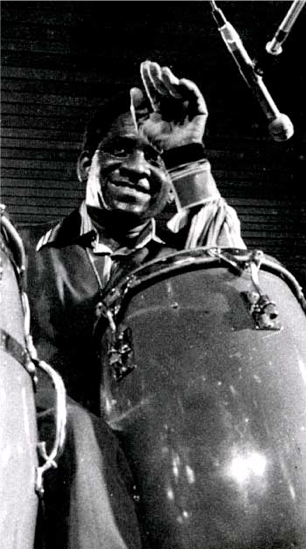] * Bugalú * Started as a fusion of rumba, mambo, African American popular music in NYC * “Mongo” Santamaria: “Watermelon Man” * Cover of a Herbie Hancock song * Listen to how late the horns are! * Precursor to salsa <audio controls="controls"> <source src="/assets/mongo-santiago-watermelon-man.m4a" type="audio/mpeg"> </audio> --- # Tito Puente * Grew up in NYC, not Cuba or PR * Born in Spanish Harlem, 1923, in a “multicultural environment” with jazz, latin, classical music * Spanish and English language, Puerto Rican parents .image-70.center[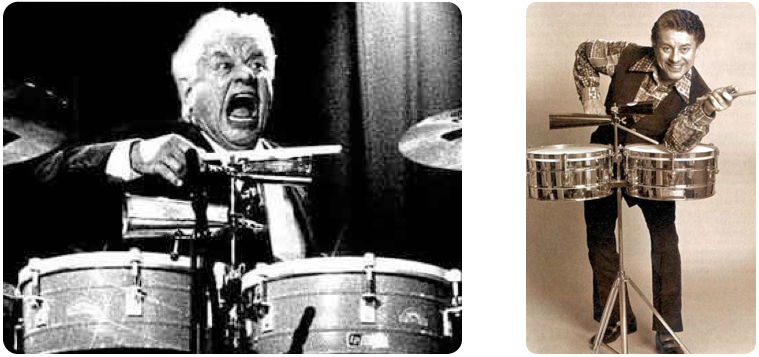] --- class: middle, center <!-- <video width="560" height="360" controls> <source src="/assets/tito-puente-timbale-solo.mp4" type="video/mp4"> <source src="/assets/tito-puente-timbale-solo.ogv" type="video/ogg"> </video> --> <iframe width="560" height="315" src="https://www.youtube.com/embed/jTN39CIvR7A?si=7OkErM5BlyzadzrO" title="YouTube video player" frameborder="0" allow="accelerometer; autoplay; clipboard-write; encrypted-media; gyroscope; picture-in-picture; web-share" referrerpolicy="strict-origin-when-cross-origin" allowfullscreen></iframe> ### Tito Puente timbale solo --- # Tito Puente * Played with Machito * Identified with Cuban music * Forms his own band in 1950, year after “Mambo #5” * Centers on “Cuban” rhythms, his timbales * Many albums, success during the “mambo craze” * “Oye Como Va” * Simple, like cha cha chá * Big band horns, groovy bass * Lyrical machismo (like guaguancó “game”) * Layers, increasing complexity * Dance music! <audio controls="controls"> <source src="/assets/tito-puente-oye-como-va.m4a" type="audio/mpeg"> </audio> --- class: middle, center <!-- <video width="560" height="360" controls> <source src="/assets/santana-soul-sacrifice-woodstock-1969.mp4" type="video/mp4"> <source src="/assets/santana-soul-sacrifice-woodstock-1969.ogv" type="video/ogg"> </video> --> <iframe width="560" height="315" src="https://www.youtube.com/embed/JaaT_HRb4GU?si=jPOAVrpx9YJZU2AQ" title="YouTube video player" frameborder="0" allow="accelerometer; autoplay; clipboard-write; encrypted-media; gyroscope; picture-in-picture; web-share" referrerpolicy="strict-origin-when-cross-origin" allowfullscreen></iframe> ### Santana at Woodstock: "Soul Sacrifice" (1969) --- class: middle, center <!-- <video width="560" height="360" controls> <source src="/assets/santana-black-magic-woman-oye-como-va.mp4" type="video/mp4"> <source src="/assets/santana-black-magic-woman-oye-como-va.ogv" type="video/ogg"> </video> --> <iframe width="560" height="315" src="https://www.youtube.com/embed/2EfAsOBjkp8?si=r0QEAudt0HkpVZxp" title="YouTube video player" frameborder="0" allow="accelerometer; autoplay; clipboard-write; encrypted-media; gyroscope; picture-in-picture; web-share" referrerpolicy="strict-origin-when-cross-origin" allowfullscreen></iframe> ### Santana: “Black Magic Woman” and "Oye Como Va" --- # Salsa * Popularity in NYC in the 1970s * Based in and around dance clubs * Rise of independent Latin-oriented record companies * Blend of Latin ballroom, Afro-Cuban drumming * According to some, this was nothing new! * Fania Records * Co-owned by Dominican-born bandleader Johnny Pacheco and Italian-American lawyer Jerry Masucci * Fania All-Stars (Blades, Colón, Barretto, Pacheco, Celia Cruz...) --- # Stars of Salsa * Eddie Palmieri * Brought jazz voicings, harmonies to the piano * Pushed compositional, harmonic limits of Latin dance * Willie Colón * Trombonist, introduced heavy brass arrangements * Included touches of W. African, Brazilian, etc. * Street-wise image, energetic, gritty sound * Rubén Blades * Panamanian singer-songwriter, actor, activist * Story-oriented songs, highlighted life in the barrio --- class: middle, center <!-- <video width="560" height="360" controls> <source src="/assets/willie-colon-and-ruben-blades-buscando-guayaba.mp4" type="video/mp4"> <source src="/assets/willie-colon-and-ruben-blades-buscando-guayaba.ogv" type="video/ogg"> </video> --> <iframe width="560" height="315" src="https://www.youtube.com/embed/PPUPyNgZBnk?si=8F5KCK-E_hSIxfnI" title="YouTube video player" frameborder="0" allow="accelerometer; autoplay; clipboard-write; encrypted-media; gyroscope; picture-in-picture; web-share" referrerpolicy="strict-origin-when-cross-origin" allowfullscreen></iframe> ### Willie Colón and Rubén Blades: “Buscando" --- # "Pedro Navaja" .image-float-right.image-40[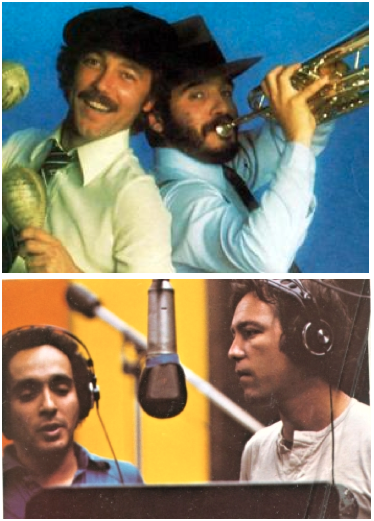] * Rough lyrics * Homage to “Mack the Knife” * Story: death of a tough guy who attacks a prostitute * Arrangement * Stars with congas, sirens * Introducing new instruments/ harmony, after you’ve hear the melody a few times * Montuno: parables, TV quotes --- Round the corner of the old neighborhood I saw him go, <br /> with the familiar gait that street toughs have. <br /> His hands always deep inside the pockets of his coat, <br /> so that nobody knows which one holds the dagger. <br /> <br /> He sports a wide-brimmed hat, tilted to one side, <br /> and sneakers, to fly when in danger. <br /> Dark shades so nobody knows what he's staring at, <br /> and a golden tooth that shines when he laughs. <br /> <br /> Three blocks away from that corner, a woman <br /> strides the entire sidewalk for the fifth time, <br /> and goes into a tenement hallway to take a swig and forget <br /> that it's a slow day, and there are no clients to service. <br /> <br /> A car passes very slowly down the avenue. <br /> It has no markings but everyone knows it's the police. <br /> Pedro Navaja, his hands always inside his coat, <br /> looks and smiles, and his gold tooth shines again. <br /> <audio controls="controls"> <source src="/assets/ruben-blades-pedro-navaja.m4a" type="audio/mpeg"> </audio> --- While walking he looks from corner to corner, <br /> Not a soul is seen, all the avenue is deserted, <br /> when this woman suddenly leaves the hallway, <br /> and Pedro Navaja clenches his fist inside his overcoat. <br /> <br /> He looks at both sides and doesn't see anyone, <br /> and running, silently, he crosses the street, <br /> and meanwhile that woman is on the other side, <br /> grumbling because she didn't make money for food. <br /> <br /> As she walks, she draws a revolver from her old coat, that woman, <br /> to put it inside her purse, so it won't hinder her. <br /> A .38 Smith and Wesson Special <br /> that she keeps always, to rid her from all evil. <br /> <br /> And Pedro Navaja, knife in hand, jumped on her, <br /> the gold tooth lighting up the entire avenue, how easy! <br /> Laughing, he stabbed her without compassion, <br /> when suddenly a shot sounded, like a cannon. <br /> <br /> And Pedro Navaja fell on the sidewalk, as he saw that woman, with <br /> the revolver in her hand, mortally wounded, telling him: <br /> "I thought, 'today is not my day, I'm on a bad streak,' <br /> but Pedro Navaja, you are worse, you are nothing." <br /> <br /> --- And believe me, guys, even though noise was made, nobody came out, <br /> nobody was curious, no questions were asked, nobody cried. <br /> Just a drunk who found the two bodies, <br /> Took the revolver, the knife, the money, and left, <br /> <br /> And stumbling, he went along singing, out of tune, <br /> the chorus I've brought you, which carries the message of my song: <br /> "Life brings you surprises, surprises are brought by life, oh God." <br /> Life brings you surprises, surprises are brought by life, oh God <br /> <br /> Pedro Navaja, killer on the corner, "he who lives by the sword, dies by the sword" <br /> Life brings you surprises, surprises are brought by life, oh God <br /> Bad-ass fisherman, you cast a bad [fishing] line, <br /> Instead of a sardine, you caught a shark <br /> <br /> **Montuno Section (Repeated phrases including:)** <br /> There are eight million stories in New York City <br /> As my grandma said, "he who laughs last, laughs best." <br /> When destiny is written, not even iron will can change it <br /> If you were born to be a hammer, nails rain down from heaven. <br /> In the neighborhood of tough guys, be careful on the sidewalk <br /> Take care, my buddy, he who does not run, flies. <br /> As in a Kafka novel, the drunkard turned at the corner. <br /> --- class: title, center, middle # Latin Dance Music: Cuban Musical Legacies  ### Christopher Witulski, Ph.D. ### College of Musical Arts