class: title, center, middle # Africa: Across the Continent  ### Christopher Witulski, Ph.D. ### College of Musical Arts --- # Outline * Diversity of African musical production * Background on the continent * Major regional styles * Mande social structure and music * West African instruments and styles --- # What is African Music? .image-60[.image-float-right[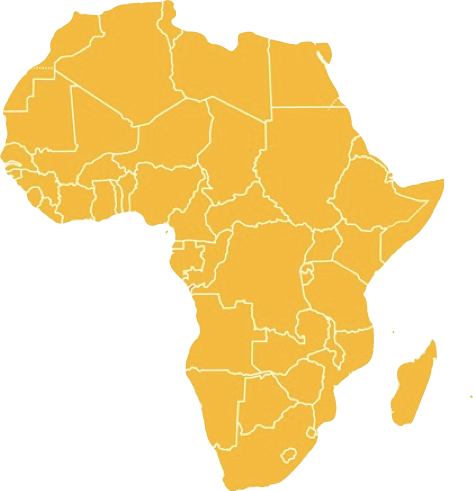]] What do you think of when you think of African music? Why? Where do those associations come from? --- class: middle, center .center[ <!-- <video width="560" height="360" controls> <source src="/assets/lion-king.mp4" type="video/mp4"> <source src="/assets/lion-king.ogv" type="video/ogg"> </video> --> <iframe width="560" height="315" src="https://www.youtube.com/embed/pYNxvVq8GQg?si=rtrsHY-qE9Lyovzt" title="YouTube video player" frameborder="0" allow="accelerometer; autoplay; clipboard-write; encrypted-media; gyroscope; picture-in-picture; web-share" referrerpolicy="strict-origin-when-cross-origin" allowfullscreen></iframe> ] ### From when I was a kid... --- # How Big is Africa? .image-60.center[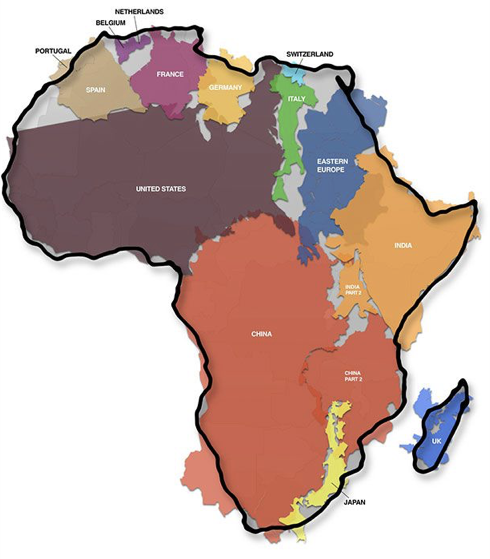] --- # What is African Music? .image-30[.image-float-right[]] * Africa is... * The second largest continent * 20% of the Earth’s surface * 25% of the population * The source of a vast diaspora * Africa contains… * Thousands of musical traditions * A huge linguistic and cultural diversity * Contrary to popular belief, it is not all drumming! --- # What is African Music? .image-30[.image-float-right[]] * Diversity of African music * Africa is not a country. Period. * Vocal ensemble traditions * BaAka hunting song, Cameroon * Isicathamiya: Ladysmith Black Mambazo, South Africa * Church hymns, all over the place * String traditions * Especially East and West Africa --- # Some History .image-30[.image-float-right[]] * Great Empires: supported arts * Mande, Ghana, Songhay, others * Foreign intervention * 15th C: Early contact (Angola) * 17th-19th C: Slave trade * 19th-20th C: Colonization by British, French, Portuguese * 1884-5: Berlin Conference * Post WW-II: Independence * Ghana first, 1957 * Others follow, string of revolutions --- # Some History .image-30[.image-float-right[]] * Indigenous religions * Deities, ancestors, nature * Often includes communal ritual * Christianity * Spread through missionary work * Supports choral styles, hymns * Ghana, Kenya for example * Islam/Sufism * Across North Africa, East coast * Heavily influenced by reformism --- # Regional Diversity .image-60[.image-float-right[]] * North Africa * Egypt to Morocco * Influence of Sufism, Arabic music --- # Regional Diversity .image-60[.image-float-right[]] * North Africa * East Africa * Ethiopia, Kenya, Uganda * The “Horn” * Remember that Ugandan track? * Arab styles thanks to trade routes --- class: middle, center .center[ <!-- <video width="560" height="360" controls> <source src="/assets/endongo-demonstration.mp4" type="video/mp4"> <source src="/assets/endongo-demonstration.ogv" type="video/ogg"> </video> --> <iframe width="560" height="315" src="https://www.youtube.com/embed/YXJt8Ew5KNc?si=ebeSr4WN-NXr64yK" title="YouTube video player" frameborder="0" allow="accelerometer; autoplay; clipboard-write; encrypted-media; gyroscope; picture-in-picture; web-share" referrerpolicy="strict-origin-when-cross-origin" allowfullscreen></iframe> ] ### Kinobe demonstrates the endongo --- class: middle, center .center[ <!-- <video width="560" height="360" controls> <source src="/assets/musical-bow.mp4" type="video/mp4"> <source src="/assets/musical-bow.ogv" type="video/ogg"> </video> --> <iframe width="560" height="315" src="https://www.youtube.com/embed/f5Sl-WFL-_c?si=kvceMRsxaM53bBbe" title="YouTube video player" frameborder="0" allow="accelerometer; autoplay; clipboard-write; encrypted-media; gyroscope; picture-in-picture; web-share" referrerpolicy="strict-origin-when-cross-origin" allowfullscreen></iframe> ] ### Tim Winsey demonstrates the “musical bow” in Burkina Faso --- # Regional Diversity .image-60[.image-float-right[]] * North Africa * East Africa * Southern Africa * Zimbabawe, South Africa * The mbira, vocal traditions --- class: middle, center .center[ <!-- <video width="560" height="360" controls> <source src="/assets/mbira-demo.mp4" type="video/mp4"> <source src="/assets/mbira-demo.ogv" type="video/ogg"> </video> --> <iframe width="560" height="315" src="https://www.youtube.com/embed/hNUoxAB8S6c?si=NnCqHVr8N6EwStAP" title="YouTube video player" frameborder="0" allow="accelerometer; autoplay; clipboard-write; encrypted-media; gyroscope; picture-in-picture; web-share" referrerpolicy="strict-origin-when-cross-origin" allowfullscreen></iframe> ] ### Shona mbira demonstration --- class: middle, center .center[ <!-- <video width="560" height="360" controls> <source src="/assets/hunters-mbira-crew.mp4" type="video/mp4"> <source src="/assets/hunters-mbira-crew.ogv" type="video/ogg"> </video> --> <iframe width="560" height="315" src="https://www.youtube.com/embed/aj-DE7Trzok?si=cfSvtJAYGF801lFC" title="YouTube video player" frameborder="0" allow="accelerometer; autoplay; clipboard-write; encrypted-media; gyroscope; picture-in-picture; web-share" referrerpolicy="strict-origin-when-cross-origin" allowfullscreen></iframe> ] ### As an ensemble: mbira, hosho, and ngoma <!-- ### Hunters Mbira Crew --> <!-- --- class: middle, center .center[<video width="560" height="360" controls> <source src="/assets/chopi-timbila.mp4" type="video/mp4"> <source src="/assets/chopi-timbila.ogv" type="video/ogg"> </video>] --> --- class: middle, center .center[ <!-- <video width="560" height="360" controls> <source src="/assets/isicathamiya.mp4" type="video/mp4"> <source src="/assets/isicathamiya.ogv" type="video/ogg"> </video> --> <iframe width="560" height="315" src="https://www.youtube.com/embed/0_OwXikNZvU?si=IMrQrDz_kI51HnxB&start=18" title="YouTube video player" frameborder="0" allow="accelerometer; autoplay; clipboard-write; encrypted-media; gyroscope; picture-in-picture; web-share" referrerpolicy="strict-origin-when-cross-origin" allowfullscreen></iframe> ] ### Isicathamiya competition in South Africa --- class: middle, center .center[ <!-- <video width="560" height="360" controls> <source src="/assets/ladysmith.mp4" type="video/mp4"> <source src="/assets/ladysmith.ogv" type="video/ogg"> </video> --> <iframe width="560" height="315" src="https://www.youtube.com/embed/aAhHGYrzj2M?si=Jtfm_lZyj65EE5fN&start=18" title="YouTube video player" frameborder="0" allow="accelerometer; autoplay; clipboard-write; encrypted-media; gyroscope; picture-in-picture; web-share" referrerpolicy="strict-origin-when-cross-origin" allowfullscreen></iframe> ] ### Paul Simon and Ladysmith Black Mambazo --- # Regional Diversity .image-60[.image-float-right[]] * North Africa * East Africa * Southern Africa * Central Africa * Cameroon, DRC * BaMbuti singing * Congolese rumba --- # Regional Diversity .image-60[.image-float-right[]] * North Africa * East Africa * Southern Africa * Central Africa * West Africa * Mali, Guinea-Bissau, Senegal, Ghana * Jeliya, Yoruba, drumming --- class: middle, center .center[ <!-- <video width="560" height="360" controls> <source src="/assets/atumpan-speech-drumming.mp4" type="video/mp4"> <source src="/assets/atumpan-speech-drumming.ogv" type="video/ogg"> </video> --> <iframe width="560" height="315" src="https://www.youtube.com/embed/ECy6ITYxiDc?si=BUcarHcRH3Js1fkB&start=18" title="YouTube video player" frameborder="0" allow="accelerometer; autoplay; clipboard-write; encrypted-media; gyroscope; picture-in-picture; web-share" referrerpolicy="strict-origin-when-cross-origin" allowfullscreen></iframe> ] ### Kwesi Adjei demonstrating Asante speech drumming on atumpan --- # Core Vimbuza Mode .image-100[] --- # What is Polymeter/Polyrhythm? .center[ .image-30[] ### Dawuro .image-100[] Do you hear a beat? Where is it? ] --- # What is Polymeter/Polyrhythm? .center[ .image-30[] ### Dawuro .image-100[] Six beats: triple meter, duple subdivision ] --- # What is Polymeter/Polyrhythm? .center[ .image-30[] ### Dawuro .image-100[] Four beats: duple meter, triple subdivision ] --- .center[ .image-30[] ### From, Atumpan (Eguankoba is like the *from* but shorter) .image-100[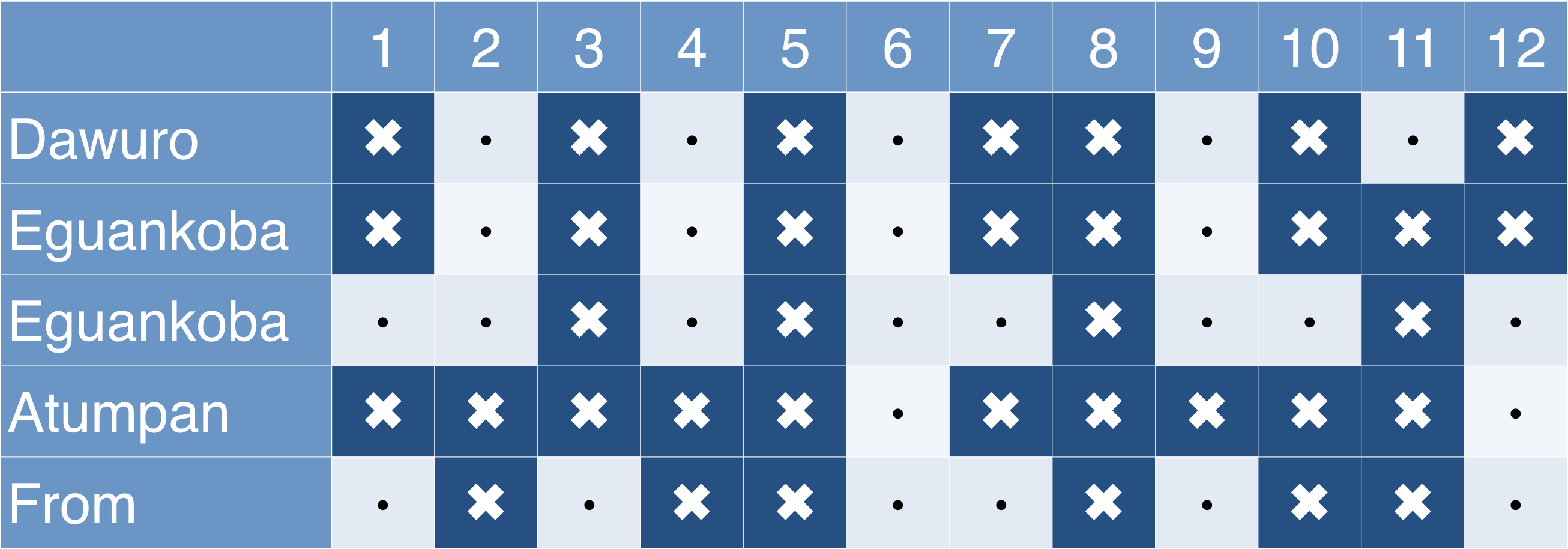] Start with *dawuro* and *atumpan* ] --- class: middle, center .center[ <iframe width="560" height="315" src="https://www.youtube.com/embed/29WwrCz8O80?si=Ss-DwLO6fitPjkn-&start=18" title="YouTube video player" frameborder="0" allow="accelerometer; autoplay; clipboard-write; encrypted-media; gyroscope; picture-in-picture; web-share" referrerpolicy="strict-origin-when-cross-origin" allowfullscreen></iframe> <!-- <video width="560" height="360" controls> <source src="/assets/fontomfrom.mp4" type="video/mp4"> <source src="/assets/fontomfrom.ogv" type="video/ogg"> </video> --> ] ### Fontomfrom clip (not exactly the same rhythms) --- class: middle, center .center[ <iframe width="560" height="315" src="https://www.youtube.com/embed/Z7OB9W0cAzs?si=NAN28rOAUoxoVS1t&start=18" title="YouTube video player" frameborder="0" allow="accelerometer; autoplay; clipboard-write; encrypted-media; gyroscope; picture-in-picture; web-share" referrerpolicy="strict-origin-when-cross-origin" allowfullscreen></iframe> <!-- <video width="560" height="360" controls> <source src="/assets/fela-and-egypt-80.mp4" type="video/mp4"> <source src="/assets/fela-and-egypt-80.ogv" type="video/ogg"> </video> --> ] ### Fela Kuti and Egypt 80: Live in Paris, 1984 --- # Musical "Africanisms" ### After all this, what broad similarities come through despite my focus on diversities? -- * Complex polyphonic textures * Layered ostinatos with varied repetition * Conversational element * Improvisation * Timbral complexity (like “buzzing”) * Distinctive pitch systems and scales --- # Musical "USA-nisms" ### To think about what these mean… ### What would be some broad similarities across American music? * What breaks the mold? --- class: title, center, middle # Africa: Across the Continent  ### Christopher Witulski, Ph.D. ### College of Musical Arts