class: title, center, middle # Ragas and Rhythms  ### Christopher Witulski, Ph.D. ### College of Musical Arts --- # Rhythm * The tal (or tala) * Rhythmic organization… like meter * Lines up with syllables * Subdivisions and drum strokes, we’ll see each --- # Rhythm .center.image-100[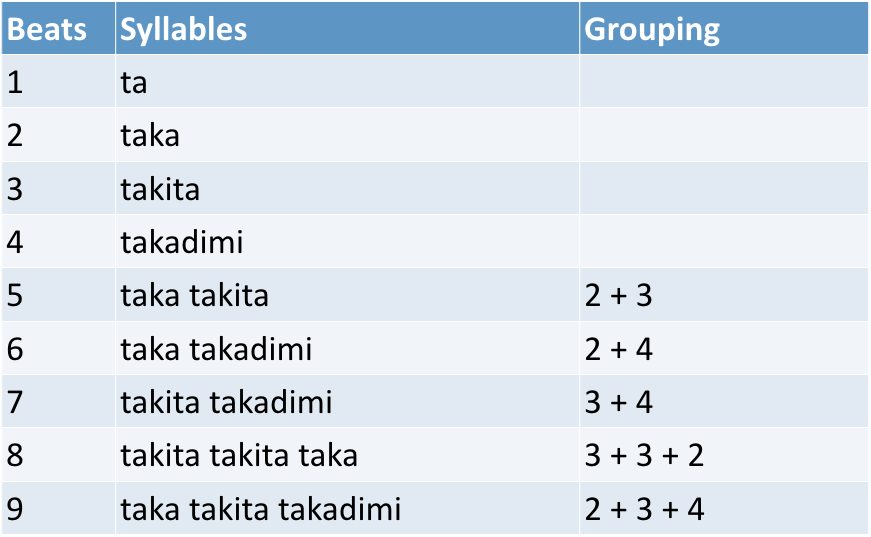] --- # Rhythm * The tal (or tala) * Rhythmic organization… like meter * Lines up with syllables * Subdivisions and drum strokes, we’ll see each -- * “Tongue Twister” * Ritesh Das Toronto Tabla Ensemble <audio controls="controls"> <source src="/assets/tongue-twister.m4a" type="audio/mpeg"> </audio> -- * Worth hearing again * Notice the pitch * Tap a pulse --- class: middle, center ### Tintal .center.image-100[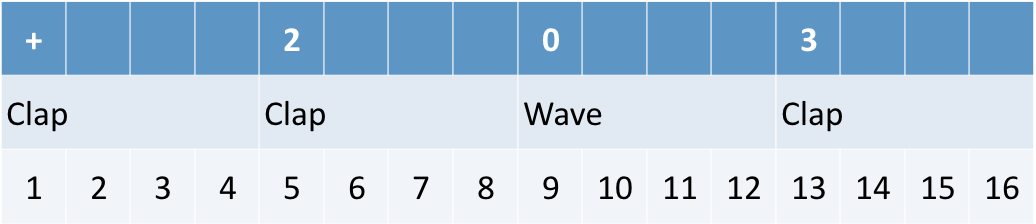] --- class: middle, center ### Tintal .center.image-100[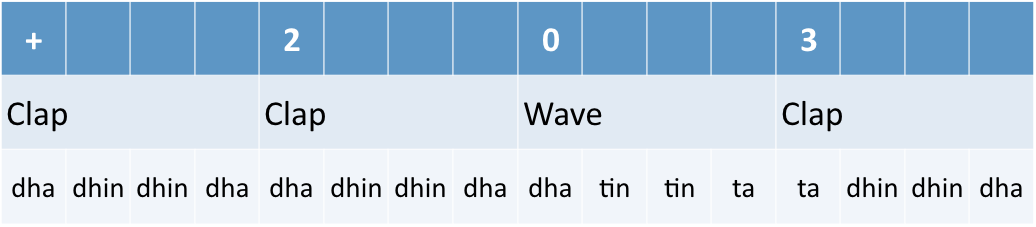] --- # Other Common Tals .image-float-right.image-60[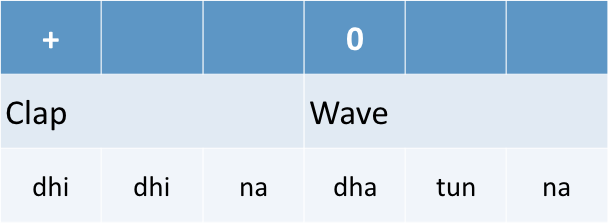] ### Dadra tal 6 beats, 3+3 <div style="clear:both;padding:10px;"></div> .image-float-right.image-60[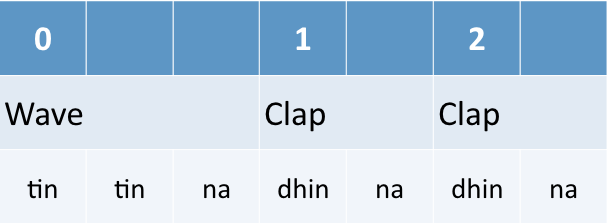] ### Rupak tal 7 beats, 3+2+2 --- # Other Common Tals .image-float-right.image-60[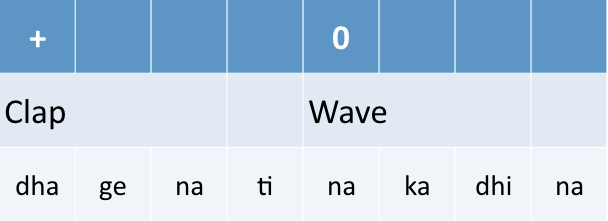] ### Keharwa tal 8 beats, 4+4 <div style="clear:both;padding:10px;"></div> .image-float-right.image-60[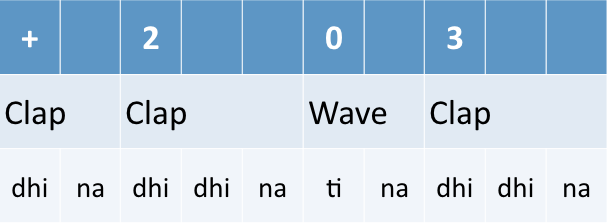] ### Jhaptal 10 beats, 2+3+2+3 --- # Other Structures * Kayda * Means rule/law * A composition that varies rhythms and sounds * Lots of symmetry, short, used often in tabla solos * Tihai * Rhythmic formulas repeated three times * Closing figure, but can be a stand-alone composition --- class: middle, center # Some Tihais .center.image-100[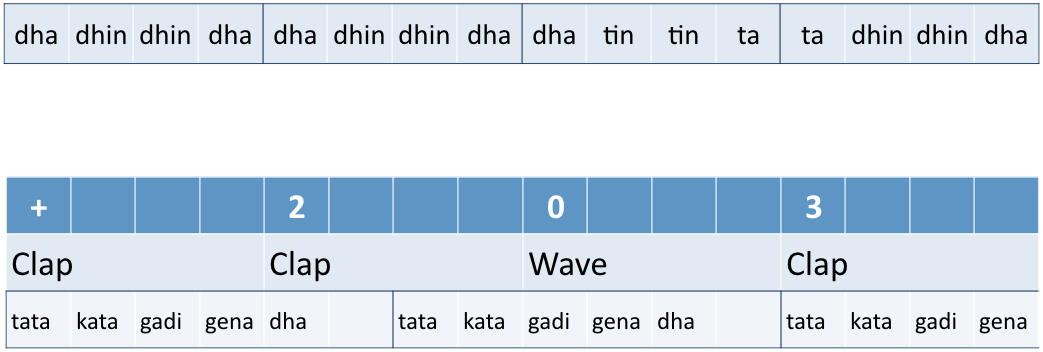] --- class: middle, center .center.image-100[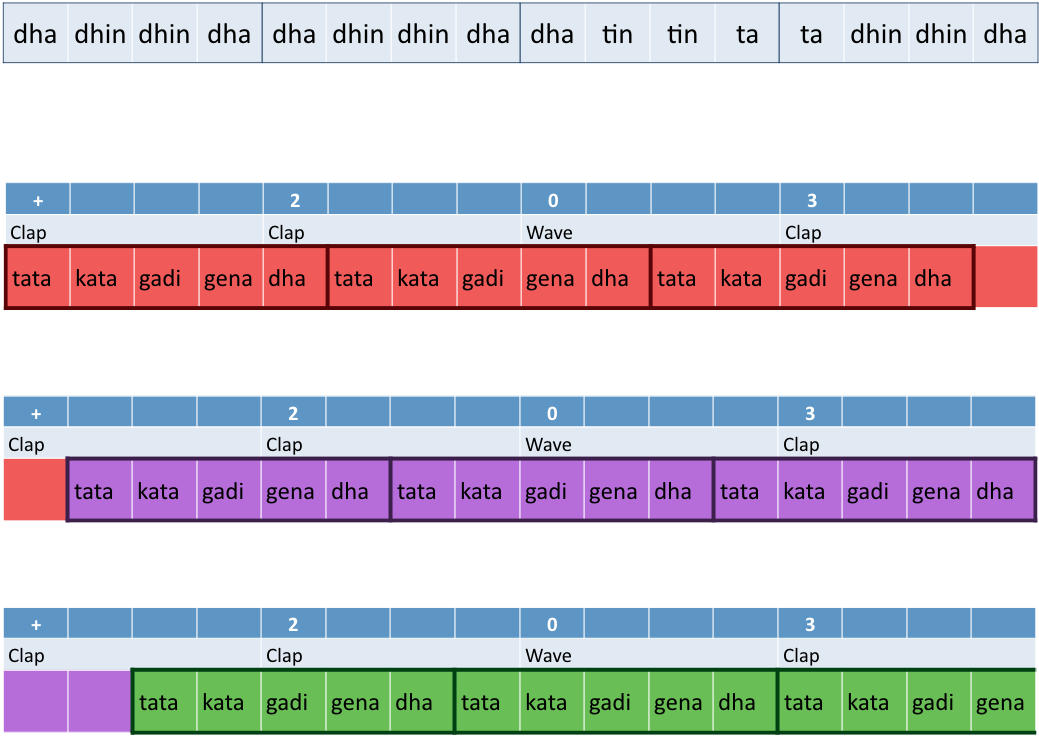] --- # Other Structures * Kayda * Means rule/law * A composition that varies rhythms and sounds * Lots of symmetry, short, used often in tabla solos * Tihai * Rhythmic formulas repeated three times * Closing figure, but can be a stand-alone composition * Alla Rakha and Zakir Hussein * Two sets of this same game… * Shows compositional structure, intentionality <audio controls="controls"> <source src="/assets/alla-rakha-chakradar-tipalli-gat.m4a" type="audio/mpeg"> </audio> --- # The Raga * Defined * A complete and self-contained melodic system * Basis for all melodic material in a composition or improvisation in that raga * Characteristics * Set of pitches * Ornamentations * Melodic motives * Extra-musical associations * Must adhere to the raga --- # The Raga * Not a “piece”: more of a template * Barhat: growth (spiritual, symbolic, and musical) * Limiting structure and a medium for innovation * Progression from slow/abstract to fast/metered * Form * Alap: improvised, free rhythm, solo, exploring pitches, gradual increase in range, leads to meter * Gat: steady beat/tala, continued growth, climactic finish marked by entrance of tabla * Interaction of composed and improvised sections --- # Raga Sindhi-Bhairavi * Ravi Shankar * Aggressive performance of a relaxed rag * Structure (introduced by Shankar) * Ascent: **B♭ C E♭ F G E♭ F A♭ B♭ C** * Descent: **C B♭ A B♭ A♭ G F E♭ G F E♭ D E♭ D♭ C** * Most basic: **C D♭ E♭ F G A♭ B♭** --- # Raga Sindhi-Bhairavi * Ravi Shankar * Aggressive performance of a relaxed rag * Structure (introduced by Shankar) * Ascent: **B♭ C E♭ F G E♭ F .red[A♭] B♭ C** * Descent: **C B♭ .red[A] B♭ .red[A♭] G F E♭ G F E♭ .blue[D] E♭ .blue[D♭] C** * Most basic: **C .blue[D♭] E♭ F G .red[A♭] B♭** -- * Sections * Alap: first five minutes * Jor: begins at 4:53 * Gat: begins at 5:52, chalan melody-improvisation * Jhala: begins at 12:36 <audio controls="controls"> <source src="/assets/ravi-shankar-raga-sindhi-bhairavi.m4a" type="audio/mpeg"> </audio> --- class: middle, center <!-- <video width="560" height="420" controls> <source src="/assets/ravi-shankar-raga-a-personal-introduction.mp4" type="video/mp4"> <source src="/assets/ravi-shankar-raga-a-personal-introduction.ogv" type="video/mp4"> </video> --> <iframe width="560" height="315" src="https://www.youtube.com/embed/X0fSUOiar0k?si=lqe7CWK0iUD5DZ2K" title="YouTube video player" frameborder="0" allow="accelerometer; autoplay; clipboard-write; encrypted-media; gyroscope; picture-in-picture; web-share" referrerpolicy="strict-origin-when-cross-origin" allowfullscreen></iframe> ### Shankar: Raga demonstration --- class: title, center, middle # Ragas and Rhythms  ### Christopher Witulski, Ph.D. ### College of Musical Arts